
Board Minutes for Dividends: The Complete UK Directors Guide (2026)
In this article12 sections
- What are board minutes for dividends?
- Legal requirements under the Companies Act 2006
- Interim vs final dividends: documentation differences
- Step 1: Prepare for the board meeting
- Step 2: Conduct the board meeting
- Step 3: Draft the board minutes
- Step 4: Approve and sign the minutes
- Step 5: Store and retain minutes properly
- Board minutes template example
- Common board minutes mistakes to avoid
- How Dividify simplifies board minutes
- FAQs
Every dividend your company declares requires proper documentation—and at the heart of that documentation sits the board minutes. Whether you're a sole director of a small limited company or part of a larger board, understanding how to create compliant board minutes for dividends is essential for staying on the right side of HMRC and Companies House.
This comprehensive guide walks you through everything UK directors need to know about board minutes for dividend declarations in 2026, from legal requirements to practical templates you can use today.
What are board minutes for dividends?
Board minutes are the official written record of decisions made during a board meeting. When it comes to dividends, these minutes document that directors have:
- Reviewed the company's financial position
- Confirmed sufficient distributable profits exist
- Formally declared a dividend payment
- Agreed on the payment amount, date, and recipients
Think of board minutes as the "paper trail" that proves your dividend was properly authorised. They protect both the company and individual directors if questions arise later about the legality of dividend payments.
Legal requirements under the Companies Act 2006
The Companies Act 2006 sets out specific requirements for maintaining company records, including board minutes:
Section 248: Minutes of directors' meetings
Under Section 248, every company must keep minutes of all proceedings at meetings of its directors. These minutes must be kept for at least 10 years from the date of the meeting.
What the law requires:
- Minutes must record decisions made at board meetings
- They must be kept at the registered office or a SAIL (Single Alternative Inspection Location)
- Directors must be able to inspect minutes without charge
- Minutes that have been signed are evidence of the proceedings
HMRC expectations
While HMRC doesn't prescribe a specific format for board minutes, they expect to see evidence that:
- Dividends were formally declared before payment
- The company had sufficient distributable profits
- Directors considered the company's financial position
- The dividend amount and payment date were clearly specified
Interim vs final dividends: documentation differences
Understanding the difference between interim and final dividends affects how you document them:
Interim dividends
- Declared by directors during the financial year
- Can be declared at board meetings without shareholder approval
- More common for small companies paying regular dividends
- Board minutes alone are sufficient documentation
Final dividends
- Declared at the end of the financial year
- Typically recommended by directors and approved by shareholders at an AGM
- Requires both board minutes (recommendation) and shareholder resolution (approval)
- More formal process but provides additional legal protection
Step 1: Prepare for the board meeting
Before holding a board meeting to declare dividends, proper preparation is essential:
Review financial position
- Check the latest management accounts
- Confirm the company has distributable profits (retained earnings)
- Ensure cash flow can support the dividend payment
- Consider any upcoming expenses or commitments
Calculate distributable profits
Distributable profits = Accumulated realised profits − Accumulated realised losses
Prepare meeting documentation
- Draft the meeting agenda
- Prepare a summary of the financial position
- Have previous dividend records available for reference
- Prepare a draft resolution for the dividend declaration
Give appropriate notice
While small companies with only one or two directors may have informal meetings, best practice is to:
- Give reasonable notice to all directors
- Share the agenda and financial summary in advance
- Allow time for directors to review the information
Step 2: Conduct the board meeting
The board meeting itself follows a structured process:
Establish quorum
Check your company's articles of association for quorum requirements. Many companies require at least two directors to be present, though single-director companies can obviously proceed with one.
Follow the agenda
A typical dividend board meeting agenda includes:
- Opening and apologies
- Review of financial position
- Confirmation of distributable profits
- Proposal of dividend resolution
- Vote on the resolution
- Confirmation of payment date and method
- Any other business
- Close of meeting
Declaration process
The chair (or sole director) should:
- Present the financial summary
- Propose the dividend amount per share
- Confirm the share class(es) receiving dividends
- State the proposed payment date
- Call for a vote on the resolution
Step 3: Draft the board minutes
The board minutes should capture all essential information about the dividend declaration:
Essential elements to include
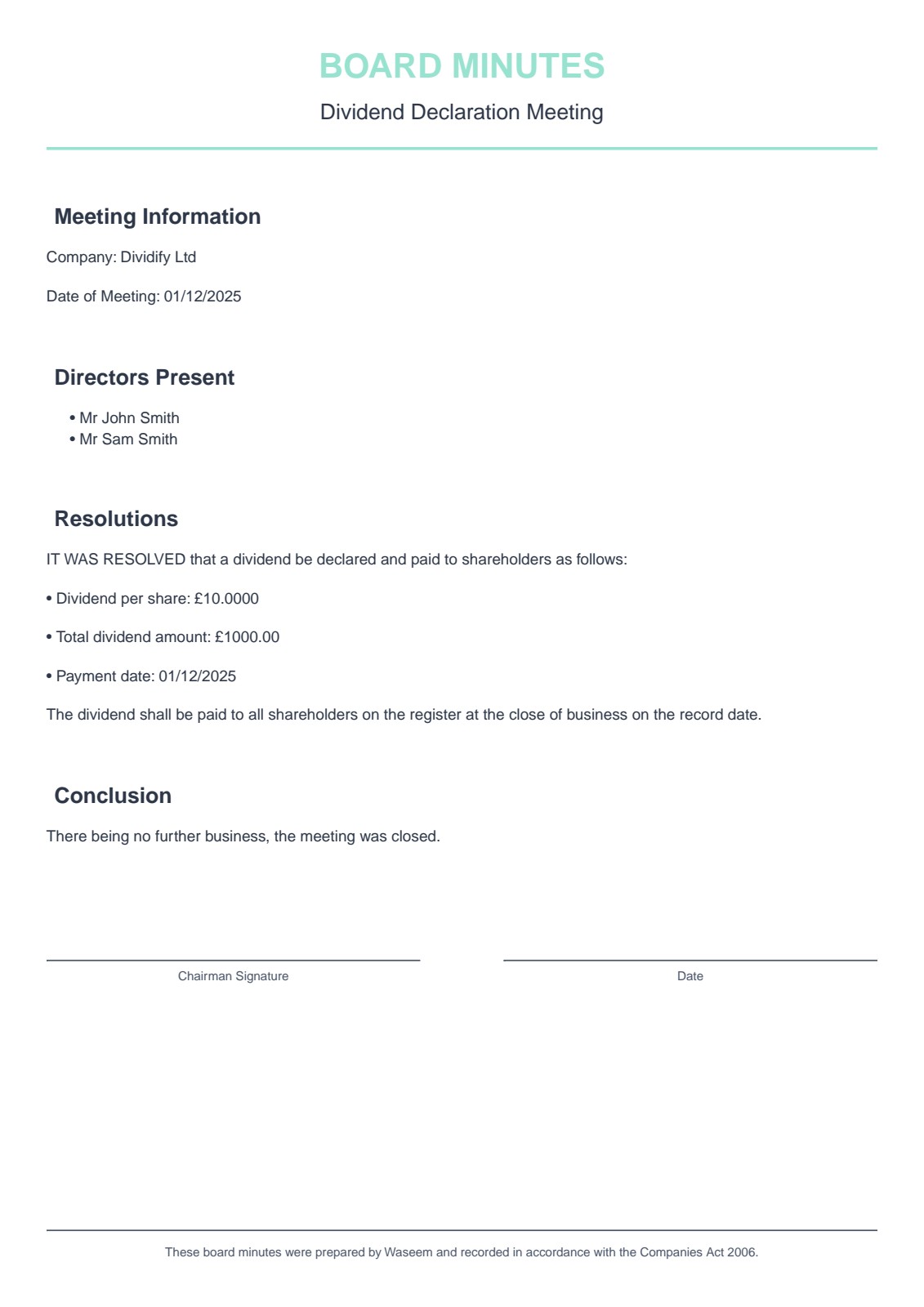
Every set of board minutes for dividends should contain:
- Company name and registration number
- Date, time, and location of the meeting
- Names of directors present (and any apologies)
- Confirmation of quorum
- Summary of financial review
- The dividend resolution (amount per share, total amount, share class)
- Payment date
- Vote outcome (e.g., "Resolved unanimously")
- Signature of the chair and date signed
Sample wording for dividend resolution
IT WAS RESOLVED that an interim dividend of £X.XX per ordinary share, totalling £X,XXX.XX, be declared and paid on [payment date] to shareholders on the register at [record date].
Common formats
Board minutes can be formatted as:
- Narrative minutes (paragraph form describing discussions)
- Resolution minutes (focused on decisions made)
- Action minutes (combining decisions with action items)
For dividend declarations, resolution-style minutes are most common and provide clear evidence of the decision.
Step 4: Approve and sign the minutes
Timing of approval
Minutes are typically approved at the next board meeting, where directors confirm they accurately record what happened. However, for small companies, minutes may be approved immediately after the meeting.
Chairman's signature
The chair of the meeting (or the sole director) should sign and date the minutes. Under the Companies Act 2006, signed minutes are evidence of the proceedings.
What if there are corrections?
If directors identify errors in the minutes:
- Corrections should be made before signing
- Major changes may require a note explaining the amendment
- Never alter signed minutes—create a supplementary minute instead
Step 5: Store and retain minutes properly
10-year retention requirement
The Companies Act 2006 requires minutes to be retained for at least 10 years from the date of the meeting. This applies even after the company is dissolved.
Storage location
Minutes must be kept at:
- The company's registered office, OR
- A Single Alternative Inspection Location (SAIL) notified to Companies House
Digital storage
Yes, you can store board minutes digitally, provided:
- They remain accessible for the full retention period
- They can be reproduced in hard copy if required
- Digital signatures (where used) meet legal requirements
- You have secure backup procedures
Board minutes template example
Here's a complete template you can adapt for your company. Click the image below to view it in full size:
Common board minutes mistakes to avoid
1. Declaring dividends without confirming distributable profits
Always document that directors reviewed the financial position and confirmed sufficient distributable profits exist.
2. Missing or incorrect dates
Ensure the meeting date, payment date, and record date are all clearly stated and consistent.
3. Failing to specify share classes
If your company has multiple share classes, clearly state which class(es) are receiving the dividend.
4. Not obtaining signatures
Unsigned minutes may be challenged by HMRC. Always have the chair sign and date the minutes.
5. Backdating minutes
Never backdate board minutes. This is fraudulent and can result in serious legal consequences.
6. Inconsistent records
Ensure your board minutes align with dividend vouchers, bank payments, and accounting records.
How Dividify simplifies board minutes
Creating compliant board minutes doesn't have to be complicated. Try Dividify Free to streamline your dividend documentation process.
Dividify helps you:
- Generate professional board minutes in minutes
- Automatically populate company and director details
- Create linked dividend vouchers for each shareholder
- Store all documents securely in the cloud
- Export to PDF for printing and signing
With Dividify, you can produce a complete set of dividend documentation—board minutes, dividend vouchers, and annual summaries—in just a few clicks. Try Dividify Free and see how easy compliant dividend management can be.
FAQs
- Do I need board minutes for every dividend?
Yes. Every dividend declaration should be supported by board minutes, regardless of the amount or frequency. This applies to both interim and final dividends.
- Can a sole director hold a board meeting?
Yes. A sole director can hold a board meeting alone. The minutes should record that the sole director reviewed the financial position and resolved to declare the dividend.
- How detailed do board minutes need to be?
Board minutes should be detailed enough to show that proper procedures were followed. At minimum, include the date, attendees, financial review confirmation, dividend details, and resolution outcome.
- What happens if I don't have board minutes?
Without board minutes, HMRC may argue that dividends weren't properly declared. This could result in dividends being reclassified as salary (with higher tax and NI implications) or as unlawful distributions.
- Can I create board minutes after paying a dividend?
Creating minutes after the fact is risky and potentially fraudulent if backdated. Best practice is to hold the board meeting and create minutes before making any dividend payments.
- Do I need a company secretary for board meetings?
No. Private limited companies are not required to have a company secretary. Directors can take and approve minutes themselves.
- How long should I keep board minutes?
The Companies Act 2006 requires companies to retain board minutes for at least 10 years from the date of the meeting.
- Can board minutes be stored electronically?
Yes. Electronic storage is acceptable provided the minutes remain accessible, can be reproduced in hard copy, and any digital signatures meet legal requirements.
Conclusion
Board minutes are a fundamental part of proper dividend management for UK limited companies. They provide legal protection for directors, satisfy HMRC requirements, and demonstrate that your company follows correct procedures.
By following the five steps outlined in this guide—prepare, meet, draft, approve, and store—you can create compliant board minutes for every dividend declaration with confidence.
Ready to simplify your dividend documentation? Try Dividify Free and generate professional board minutes, dividend vouchers, and annual summaries in minutes.